 Coinex
: how limit and market orders differed
CoinEx's former trading services used limit orders to constrain execution prices and market orders to seek immediate matches against available liquidity. The trade-off was price control versus exposure to slippage, with neither order type guaranteeing a complete fill.
The cryptocurrency exchange is in wind-down. The CoinEx Team's Important Notice on CoinEx's Orderly Cessation of Operations , published September 14, 2026, scheduled futures trading to end on September 22, 2026 and spot trading on September 29, 2026. It also provided for cancellation of unfilled futures orders and unexecuted spot orders at their respective closures.
Price limits and available liquidity
A buy limit set the highest acceptable execution price; a sell limit set the lowest. An order could remain partly or wholly unfilled if suitable opposing orders were unavailable. CoinEx's Terms of Service did not guarantee execution even when the market price was within the order's limit.
Market orders used the prices of available opposing orders. Matching across several price levels could produce an execution price that differed from the price expected before submission. That difference is slippage.
In its futures explanation, CoinEx Academy specified that insufficient opposing liquidity caused the unmatched part of a market order to be canceled. If there were no opposing orders at all, the market order could not be submitted. Seeking immediate execution therefore did not guarantee that the requested quantity would trade.
How execution policies affected orders
CoinEx's spot execution guide described separate policies for how long an order could remain active and whether it could take existing liquidity.
- Always valid
- During normal operation, the order remained active until it was fully filled or canceled.
- Immediate or cancel (IOC)
- The quantity that could execute immediately was filled, and any remainder was canceled. Partial fills were possible.
- Fill or kill (FOK)
- The entire order had to execute immediately. Otherwise, it was canceled without a partial fill.
- Maker only
- An order that would immediately match an existing order was canceled. This policy prevented the order from taking existing liquidity.
IOC and FOK allowed a limit price to be combined with an immediate execution condition. Choosing a limit order did not necessarily mean leaving an order waiting on the book.
How futures stop orders reached matching
A stop condition added an activation stage to the limit or market order. The v2 futures API allowed the trigger reference to be the latest price, mark price or index price. Its
trigger_price
was separate from the limit
price
used by a limit order.
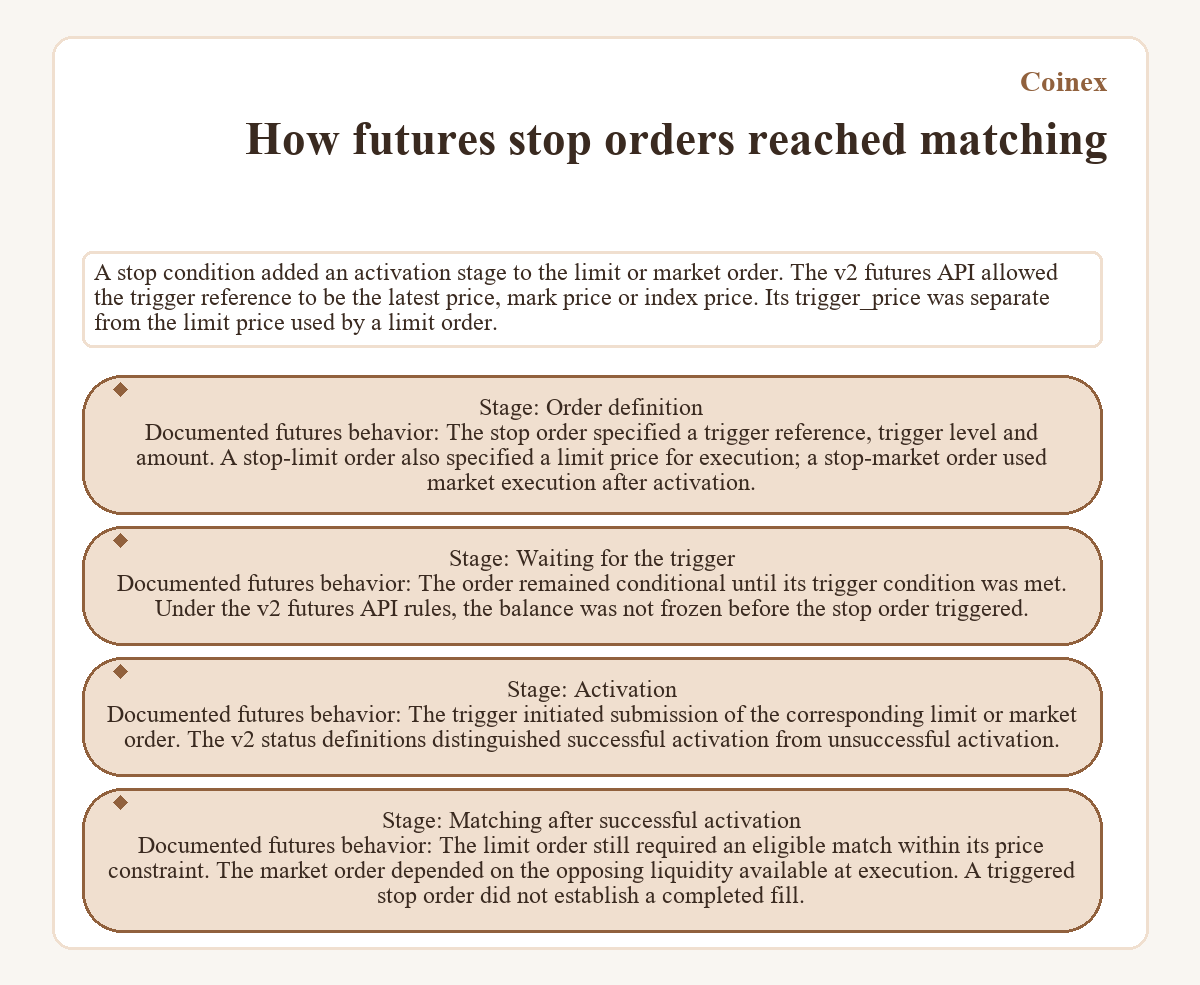
| Stage | Documented futures behavior |
|---|---|
| Order definition | The stop order specified a trigger reference, trigger level and amount. A stop-limit order also specified a limit price for execution; a stop-market order used market execution after activation. |
| Waiting for the trigger | The order remained conditional until its trigger condition was met. Under the v2 futures API rules, the balance was not frozen before the stop order triggered. |
| Activation | The trigger initiated submission of the corresponding limit or market order. The v2 status definitions distinguished successful activation from unsuccessful activation. |
| Matching after successful activation | The limit order still required an eligible match within its price constraint. The market order depended on the opposing liquidity available at execution. A triggered stop order did not establish a completed fill. |
Order amounts and fill records
For market orders in the v2 spot and margin API,
ccy
could specify either the market's base currency or its quote currency. The requested
amount
therefore needed to be read with its currency, rather than treated as a unit-free quantity or automatically interpreted as the amount received.
Order responses reported
filled_amount
and
unfilled_amount
separately. A returned
order_id
identified an order; it did not establish that the entire requested amount had traded.
· updated